
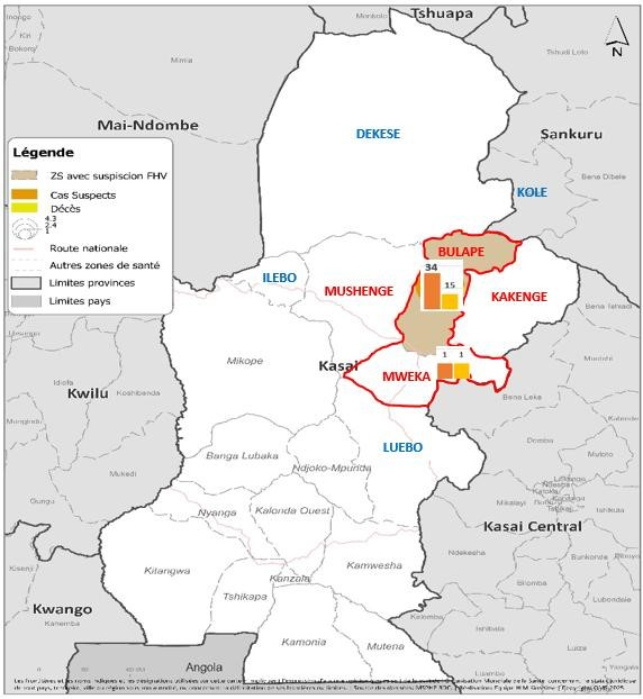
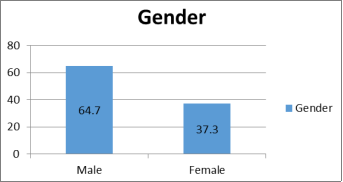
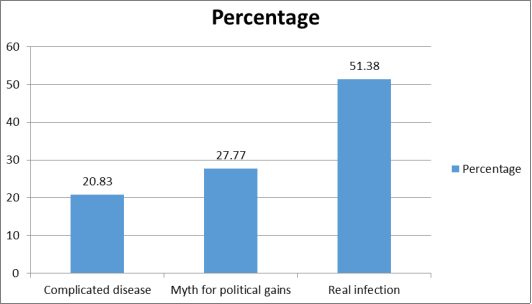
Ebola outbreaks are a significant public health problem in the DRC. The sixteen outbreaks occurred from September to December 2025 in Bulape (Mweka) with fatality ratio (FR) of 67.2%. This research explored Perception, knowledge, attitude and practice concerning Ebola Disease by the community in Bulape (DRC). This is a cross-sectional descriptive study, conducted in Bulape (Mweka) where the sixteen Ebola outbreaks occurred, from 15 th to 30 Th November 2025, using a semi structured questionnaire to collect data. Excel 2013 and SPSS.20 were used for data analysis. A total of 72 respondents were interviewed, with ages between 18 to 57 years. 64.7% were male and 35, 3% were female. 88.81% recognized that bats, are the main vector of Ebola disease; 98.6% of our respondents knew that Ebola could be transmitted through the digestive tract; and Most of our respondents knew main symptoms of Ebola diseases; While 84.72% have been washing hands regularly with soap and water to protect against Ebola virus; Also, 97.2% had got the Ebola vaccine to protect against the disease. Among them 15 (20.83%) of our respondents considered Ebola as a complicated disease, while 20 (27.77%) considered it as a myth for political gains; and 37 (51.38%) of our respondents confirmed that the Ebola virus infection was a real infection. This research has highlighted that most of the community members in Bulape had a good knowledge of EVD and knew about bats as the main vectors and Monkeys as main host of EVD, even that some continue to consider it as an unexplainable disease or myth for political gain.
| Published in | World Journal of Public Health (Volume 11, Issue 3) |
| DOI | 10.11648/j.wjph.20261103.15 |
| Page(s) | 271-277 |
| Creative Commons |
This is an Open Access article, distributed under the terms of the Creative Commons Attribution 4.0 International License (http://creativecommons.org/licenses/by/4.0/), which permits unrestricted use, distribution and reproduction in any medium or format, provided the original work is properly cited. |
| Copyright |
Copyright © The Author(s), 2026. Published by Science Publishing Group |
Ebola Outbreak, Perception, KAP, Bulape, DRC
Variables | n | Percentage (%) |
|---|---|---|
Have you ever heard of Ebola | ||
Yes | 72 | 100 |
No | 0 | 0 |
Main host and vector of the Ebola Virus | 64 | |
Bats | 72 | 88.8 |
Monkeys/Chimps | 18 | 100 |
Others (meat bush) | 0 | 25 |
Don’t know | 0 | |
Transmission | 71 | |
Digestive tract | 5 | 98.6 |
Mosquito bite | 68 | 6.94 |
Shaking hands | 66 | 94.4 |
Burial ceremony of infected person | 42 | 91.6 |
Others (Sex, …) | 56.9 | |
Signs and symptoms | ||
Fever, | 71 | 98.6 |
Headache, | 72 | 100 |
Muscle pain, | 63 | 87.5 |
Diarrhea, | 69 | 95.8 |
Vomiting, | 70 | 97.2 |
Fatigue, | 54 | 75 |
Sore throat | 32 | 44.4 |
Others | 14 | 19.4 |
Variables | n | Percentage (%) |
|---|---|---|
Washing hands | ||
Yes | 61 | 84.7 |
No | 11 | 15.3 |
Vaccine | ||
Yes | 70 | 97.2 |
No | 2 | 2.7 |
Educational status | Perceptions of the respondents | ||||
|---|---|---|---|---|---|
Complicated diseases | Myth for political gains | Real infection | Total (%) | p value | |
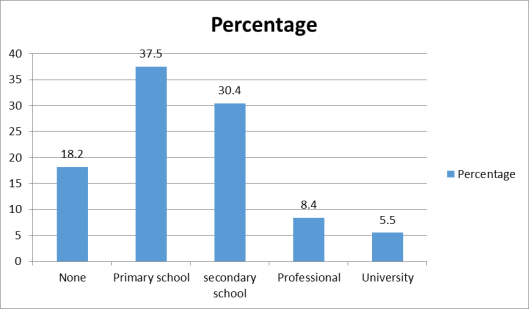
None | 11.1% (8) | 4.2% (3) | 2.7% (2) | 18.2% | 0.076 |
Primary | 2.7% (2) | 2.7% (2) | 32.1% (23) | 37.5% | 0.004 |
Secondary | 4.2% (3) | 12.5% (9) | 13.7%(10) | 30.4% | 0.001 |
Professional | 2.7%(2) | 5.6% (4) | 0 | 8.4% | 0.059 |
University | 0 | 2.7% (2) | 2.7%(2) | 5.5% | 0.103 |
Total | 20.8% | 27.7% | 51.4% | 100 | |
DRC | Democratic Republic of Congo |
EVD | Ebola Virus Diseases |
FR | Fatality Ratio |
KAP | Knowledge Attitude and Practice |
| [1] |
Emerging and re-emerging hemorrhagic fever causing viruses in recent years. Cited on April 25 2026
https://www.sciencedirect.com/science/chapter/edited-volume/abs/pii/B9780443138331000041 |
| [2] | D. Passi, S Sharma, S. R Dutta, P. Dudeja, V. Sharma, Ebola virus disease (the killer virus); another threat to humans and bioterrorism: brief review and recent updates, J. Clin. Diagn. Res., 9 (6) (2015), p. LE01, |
| [3] | K. Dhama, Y. S. Malik, S. V. S. Malik, R. K Singh, Ebola from emergence to epidemic; the virus and the disease, global preparedness and perspectives, J. Infect. Dev. Ctries., 9 (5) (2015), pp. 441-455. |
| [4] | World Health Organization, Ebola disease factsheet, accessed 1 April 2026. |
| [5] |
World Health Organization, Ebola Virus disease-Democratic Republic of the Congo,
https://www.who.int/emergencies/disease-outbreak-news/item/2025-DON589 |
| [6] | Milambo JPM. Uncovering the Drivers of Ebola Virus Disease Resurgence in DRC: A Root Cause Analysis of the 16th Outbreak in Mwaka, Kasai Province (2025). Research Square; 2025 [cité 25 avr 2026]. Disponible sur: |
| [7] | Singh R. K., Dhama K., Malik Y. S., Ramakrishnan M. A., Karthik K., Khandia R., Tiwari R., Munjal A., Saminathan M., Sachan S. Ebola virus-epidemiology, diagnosis, and control: threat to humans, lessons learnt, and preparedness plans-an update on its 40 year's journey. Vet. Q. 2017; 37(1): 98-135. |
| [8] | Tahmo NB, Wirsiy FS, Nnamdi DB, Tongo M, Lawler JV, Broadhurst MJ, et al. An epidemiological synthesis of emerging and re-emerging zoonotic disease threats in Cameroon, 2000-2022: a systematic review. IJID Reg. 1 juin 2023; 7: 84‑109. |
| [9] | Leroy EM, Kumulungui B, Pourrut X, Rouquet P, Hassanin A, Yaba P, Délicat A, Paweska JT, Gonzalez JP, Swanepoel R. Fruit bats as reservoirs of Ebola virus. Nature. 2005; 438: 575-576. |
| [10] | Ifrc- Democratic Republic of the Congo (DRC), Emergency Appeal MDRCD047 – Ebola. |
| [11] | Mulongo M, Matovu JKB, Lubaale YAM, Olupot-Olupot P. Incidence and Predictors of Secondary Transmission of Ebola among Contacts in Central Uganda in 2022: A Retrospective Cohort Study. Research Square; 2024 [cité 25 avr 2026]. |
| [12] |
Bryan ME, Vivalya BMN, Geisbert TW, Judson SD, Munster V. Ebola virus in Kasai revives 50-year-old questions on viral latency. [cité 25 avr 2026]. Disponible sur:
https://www.thelancet.com/journals/lancet/article/PIIS0140-6736(25)01973-7/fulltext |
| [13] |
Wilken J. A., Pordell P., Goode B., Jarteh R., Miller Z., Saygar B. G., et al. vol. 32. 2017 Dec 27. (Knowledge, Attitudes, and Practices Among Members of Households Actively Monitored or Quarantined to Prevent Transmission of Ebola Virus Disease — Margibi County). Liberia: February-March 2015. Prehosp Disaster Med [cited 2019 Jun 17] (6): 673-8.
https://www.cambridge.org/core/product/identifier/S1049023X17006720/type/journal_article |
| [14] | Buli B. G., Mayigane L. N., Oketta J. F., Soumouk A., Sandouno T. E., Camara B., et al. Misconceptions about Ebola seriously affect the prevention efforts: KAP related to Ebola prevention and treatment in Kouroussa Prefecture, Guinea. Pan Afr Med J. 2015; 22: 1-11. |
| [15] | Shittu O. R., Sanni A. M., Odeigah O. L., II A. A., Sule G. A., Isiaka-Lawal S., et al. Awareness, knowledge and misconceptions about Ebola virus disease (EVD) in a family practice setting in Nigeria, West Africa. J. Antivir. Antiretrovir. 2015. |
| [16] | Adongo P. B., Tabong P. T.-N., Asampong E., Ansong J., Robalo M., Adanu R. M. In: PLoS One. Boni M. F., editor. 2016 Feb 18. Beyond knowledge and awareness: addressing misconceptions in Ghana's preparation towards an outbreak of Ebola virus disease. [cited 2019 Jun 17]; vol. 11(2). |
| [17] | Jalloh M. F., Robinson S. J., Corker J., Li W., Irwin K., Barry A. M., et al. Knowledge, attitudes, and practices related to Ebola virus disease at the end of a national epidemic — Guinea, august 2015. Morb. Mortal. Wkly. Rep. 2017 Oct 20; 66(41): 1109-15. [cited 2019 Jun 20]. |
| [18] | Jude Mary Cénat, Cécile Rousseau, Rose Darly Dalexis, Jacqueline Bukaka, Daniel Derivois, Oléa Balayulu-Makila, Jean-Pierre Birangui; Knowledge and misconceptions related to the Ebola Virus Disease among adults in the Democratic Republic of the Congo: The venomous snake under the Table of prevention, Public Health Pract (Oxf). 2021 Aug 30; 2: 100178. |
APA Style
Aurelie, K. K., Sephora, S. S., Guy, M. M. (2026). A Point Assessment on Perception, Knowledge, Attitude and Practice on Ebola Disease in the Community of Bulape During the Sixteen Outbreaks in the DR Congo. World Journal of Public Health, 11(3), 271-277. https://doi.org/10.11648/j.wjph.20261103.15
ACS Style
Aurelie, K. K.; Sephora, S. S.; Guy, M. M. A Point Assessment on Perception, Knowledge, Attitude and Practice on Ebola Disease in the Community of Bulape During the Sixteen Outbreaks in the DR Congo. World J. Public Health 2026, 11(3), 271-277. doi: 10.11648/j.wjph.20261103.15
@article{10.11648/j.wjph.20261103.15,
  author = {Kasangye Kangoy Aurelie and Shambuwa Saleh Sephora and Mutangala Muloye Guy},
  title = {A Point Assessment on Perception, Knowledge, Attitude and Practice on Ebola Disease in the Community of Bulape During the Sixteen Outbreaks in the DR Congo},
  journal = {World Journal of Public Health},
  volume = {11},
  number = {3},
  pages = {271-277},
  doi = {10.11648/j.wjph.20261103.15},
  url = {https://doi.org/10.11648/j.wjph.20261103.15},
  eprint = {https://article.sciencepublishinggroup.com/pdf/10.11648.j.wjph.20261103.15},
  abstract = {Ebola outbreaks are a significant public health problem in the DRC. The sixteen outbreaks occurred from September to December 2025 in Bulape (Mweka) with fatality ratio (FR) of 67.2%. This research explored Perception, knowledge, attitude and practice concerning Ebola Disease by the community in Bulape (DRC). This is a cross-sectional descriptive study, conducted in Bulape (Mweka) where the sixteen Ebola outbreaks occurred, from 15 th to 30 Th November 2025, using a semi structured questionnaire to collect data. Excel 2013 and SPSS.20 were used for data analysis. A total of 72 respondents were interviewed, with ages between 18 to 57 years. 64.7% were male and 35, 3% were female. 88.81% recognized that bats, are the main vector of Ebola disease; 98.6% of our respondents knew that Ebola could be transmitted through the digestive tract; and Most of our respondents knew main symptoms of Ebola diseases; While 84.72% have been washing hands regularly with soap and water to protect against Ebola virus; Also, 97.2% had got the Ebola vaccine to protect against the disease. Among them 15 (20.83%) of our respondents considered Ebola as a complicated disease, while 20 (27.77%) considered it as a myth for political gains; and 37 (51.38%) of our respondents confirmed that the Ebola virus infection was a real infection. This research has highlighted that most of the community members in Bulape had a good knowledge of EVD and knew about bats as the main vectors and Monkeys as main host of EVD, even that some continue to consider it as an unexplainable disease or myth for political gain.},
 year = {2026}
}
TY  - JOUR
T1  - A Point Assessment on Perception, Knowledge, Attitude and Practice on Ebola Disease in the Community of Bulape During the Sixteen Outbreaks in the DR Congo
AU  - Kasangye Kangoy Aurelie
AU  - Shambuwa Saleh Sephora
AU  - Mutangala Muloye Guy
Y1  - 2026/07/30
PY  - 2026
N1  - https://doi.org/10.11648/j.wjph.20261103.15
DO  - 10.11648/j.wjph.20261103.15
T2  - World Journal of Public Health
JF  - World Journal of Public Health
JO  - World Journal of Public Health
SP  - 271
EP  - 277
PB  - Science Publishing Group
SN  - 2637-6059
UR  - https://doi.org/10.11648/j.wjph.20261103.15
AB  - Ebola outbreaks are a significant public health problem in the DRC. The sixteen outbreaks occurred from September to December 2025 in Bulape (Mweka) with fatality ratio (FR) of 67.2%. This research explored Perception, knowledge, attitude and practice concerning Ebola Disease by the community in Bulape (DRC). This is a cross-sectional descriptive study, conducted in Bulape (Mweka) where the sixteen Ebola outbreaks occurred, from 15 th to 30 Th November 2025, using a semi structured questionnaire to collect data. Excel 2013 and SPSS.20 were used for data analysis. A total of 72 respondents were interviewed, with ages between 18 to 57 years. 64.7% were male and 35, 3% were female. 88.81% recognized that bats, are the main vector of Ebola disease; 98.6% of our respondents knew that Ebola could be transmitted through the digestive tract; and Most of our respondents knew main symptoms of Ebola diseases; While 84.72% have been washing hands regularly with soap and water to protect against Ebola virus; Also, 97.2% had got the Ebola vaccine to protect against the disease. Among them 15 (20.83%) of our respondents considered Ebola as a complicated disease, while 20 (27.77%) considered it as a myth for political gains; and 37 (51.38%) of our respondents confirmed that the Ebola virus infection was a real infection. This research has highlighted that most of the community members in Bulape had a good knowledge of EVD and knew about bats as the main vectors and Monkeys as main host of EVD, even that some continue to consider it as an unexplainable disease or myth for political gain.
VL  - 11
IS  - 3
ER  -
School of Public Health, University of Lubumbashi, Lubumbashi, DR Congo
School of Public Health, University of Lubumbashi, Lubumbashi, DR Congo
Department of Gynaecology and Obstetrics, University of Lubumbashi, Lubumbashi, DR Congo

Information



 Share This Article
 Twitter
 Linked In
 Facebook
 Copy
Copy Download